


Let’s look at a linear regression.
In the image below, there are 194 dots. Just 14 touch the line. That’s approximately 7%. The other 93% fall somewhere above or below it.
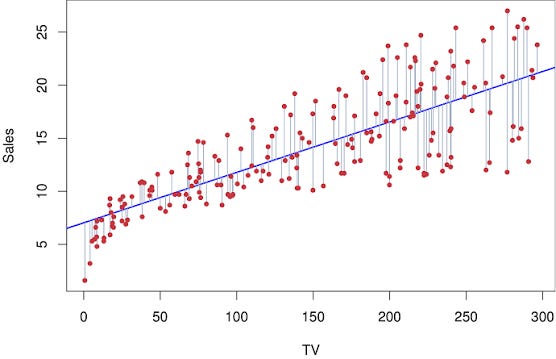
The line isn’t useless for telling the location of each dot. It captures a trend. But knowing the trend is very different from knowing where the next dot will land.
Venture capital has a similar problem.
In a traditional power-law venture portfolio, roughly 60% of investments might lose money, 25–30% generate modest returns, 5–10% become meaningful winners, and a tiny handful deliver the exceptional outcomes that drive fund performance.
In other words, the best venture investors can be wrong far more often than they’re right and still generate extraordinary returns.
Who cares? They’re making money, right?
Well, that depends.
A Different Model for Venture Returns
For years, a different model has existed. One built around being right more frequently, accepting lower individual return multiples (say, 2–5x), and dramatically reducing the loss ratio.
You’re less likely to own the next Anthropic. But you’re also less dependent on finding it.
Lead Edge Capital has pursued a version of this strategy since 2009. And we’re seeing variations of this philosophy emerge earlier in the company lifecycle, including with Jesse Pujji’s Gateway.
I believe this approach will become increasingly important because the distribution of venture outcomes is about to change.
My macro prediction is that the next era of venture will have fewer truly extraordinary winners, but those winners will be bigger than ever.
Then there will be an enormous gap.
Below that gap, I believe we’ll see an explosion of $50M-$500M outcomes and significantly more mid-market transaction volume.
If I’m right, traditional venture portfolio construction becomes increasingly difficult to justify outside the small number of firms capable of consistently accessing and identifying the biggest outliers.
Everyone else will need to adapt.
This means more flexible investment structures, more disciplined entry prices, more creative paths to liquidity, and, critically, being right more often.
Pattern Matching Is Not Knowledge
Which brings me back to pattern matching.
In 2010, Ben Horowitz wrote about the difference between pattern matching and knowledge in his article, Four Things Some VCs Do That I Don’t Like:
“A pattern-matched instruction without a rationale provides very little help.”
He was right then. He’s even more right now.
The venture industry has spent decades elevating pattern recognition as a competitive advantage. And to be fair, it can be one. But pattern matching without understanding is just a sophisticated way to be confidently wrong.
The best advice comes from specificity. From someone who deeply understands your company, your circumstances, and the actual problem you’re trying to solve. Without that context, advice becomes little more than recycled conventional wisdom, increasingly indistinguishable from boilerplate AI-generated recommendations.
The problem is that advice can sound brilliant while being completely inapplicable.
A pattern may tell you what happened before. It doesn’t necessarily explain why it happened, whether the underlying conditions still exist, or whether those conditions apply to the company sitting in front of you.
That distinction matters enormously, both for investors deciding where to deploy capital and for founders deciding whose advice to follow.
What This Means for Investors
For investors, the bar is going up. Competition will compress returns. Outliers will be harder to access, and the ability to generate consistent, repeatable outcomes will become more valuable.
The traditional power-law model won’t disappear. There will always be firms capable of generating extraordinary returns by identifying and owning a small number of exceptional businesses. But the number of firms that can successfully execute that strategy may be far smaller than the number attempting it. Those that cannot consistently access the biggest outcomes will need a different approach to generating returns.
That may mean smaller funds, greater ownership discipline, structured investments, or strategies that place more value on predictable, moderate returns than on the remote possibility of a 100x outcome.
The next generation of great investors won’t simply be the best pattern matchers. They’ll be the ones who can distinguish patterns from actual insight, adapt their structures, and make good decisions more consistently.
What This Means for Founders
For founders, the implications are equally important. Investor alignment matters enormously. And so does owning your decisions.
You live inside your business every day. Your investors don’t. No matter how experienced they are, they will never have the same depth of context you do. Their experience is valuable. They’ve seen other businesses, other markets, other teams, and other outcomes. That perspective can help you see around corners.
But their experience is not a substitute for understanding your particular circumstances. Your responsibility is to give them enough context to provide useful advice, listen carefully even when you disagree, and then confidently articulate your position so everyone can move forward together.
Sometimes that means recognizing that an investor has identified something you’ve missed. Other times it means recognizing that their advice is based on a pattern that doesn’t apply to you.
Both require intellectual honesty. Don’t mistake experience for expertise in your specific situation. And don’t confuse confidence with correctness.
The best founder-investor relationships are not built on unquestioning agreement. They’re built on the ability to challenge assumptions, share context, and arrive at better decisions together.
The End of Predictability
Competition is good for markets, but it’s unforgiving to people whose advantage was built on yesterday’s patterns.
As capital becomes more competitive, information becomes more accessible, and exceptional outcomes become more concentrated, the industry will have to rethink what constitutes a sustainable investment advantage.
The investors who adapt will survive. Those who don’t will either need to find the increasingly rare outliers or face the prospect of underperforming more liquid alternatives.
The same principle applies to the advice they provide. Pattern recognition will always have a place in venture capital. But it cannot replace judgment, context, or genuine understanding.
The next era of venture will reward adaptability, discipline, and being right more often.
The line might show you the trend. It won’t tell you where the next dot lands.