


If it was on Substack, it must be true.
The world is changing incredibly fast. Public software company valuations are falling through the floor. Startup financing is either untethered from reality or suddenly much harder to come by. At the same time, the cost of building software is approaching zero.
Layer on top of that the most powerful technology humans have ever invented improving at a rate that is hard to fathom. Uncertainty is everywhere.
When the present feels chaotic, it’s often useful to look backwards.
During the Industrial Revolution, machines like the Spinning Jenny and the Power Loom wiped out entire categories of work. Hand weavers, cottage textile workers, and skilled artisans who produced cloth manually suddenly found themselves competing against machines that could produce fabric dramatically faster and cheaper. Workers famously protested, most notably the Luddites, fearing permanent unemployment. The language they used sounds strikingly similar to what we hear today about AI creating a “permanent underclass.”
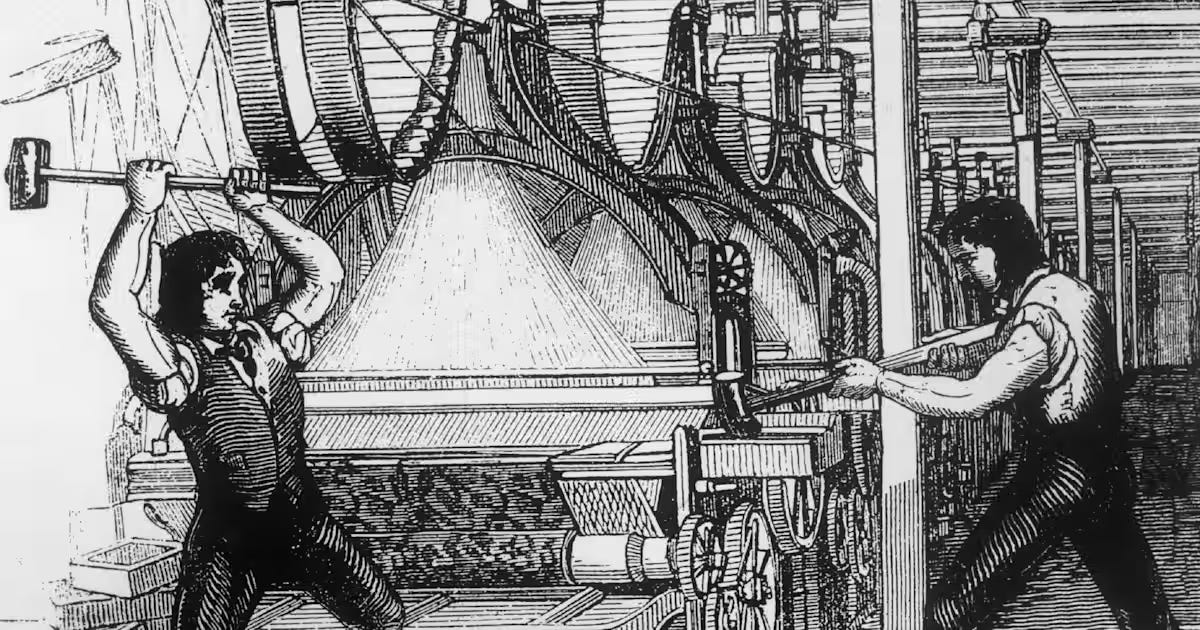
But the net effect of the Industrial Revolution was the opposite of what many feared. Textile production exploded. Clothing became dramatically cheaper. And total employment in textile manufacturing actually increased, just in different roles.
We saw the same pattern repeat itself in later waves of innovation. The automobile displaced the horse economy. ATMs were supposed to eliminate bank tellers. Personal computers replaced typing pools. Each wave destroyed certain jobs while creating entirely new industries on the other side.
Today we find ourselves in another period of real uncertainty. The macroeconomic picture is shaky and the technology curve is steep. We are already seeing early signs of disruption in the labor market, particularly for early-career professionals.
The promise of AI is extraordinary. The fears are well-founded.
When blog posts written by people nobody has heard of go viral and move public markets, it’s a good signal that people are afraid. Fear tends to dominate the narrative during moments like this.
What many of these conversations miss is that a large number of so-called “software companies,” particularly those selling into compliance-heavy or slow-moving industries, are not really software businesses in the traditional sense. They are compliance businesses, distribution businesses, and trust businesses. The software itself is often the easiest part of what they have built. That reality gives many of these companies more durability than the market currently assumes.
At the same time, the barriers to building new software have collapsed. This wave of technology will allow new entrants to expand into areas that have historically been dominated by legacy incumbents. Terrible, decades-old systems of record may finally begin to break in some industries. Inside those systems, much more work will become automated. Interfaces will simplify, often reverting to chat or voice, and long, multi-step workflows will collapse into a single request.
The economics of software companies may change as well. More companies will become successful with far fewer employees. The era of software businesses hemorrhaging money indefinitely appears to be ending. Increasingly, these companies will be judged the way most businesses always have been: on their ability to generate real profits.
Alongside that shift, we will almost certainly see entirely new categories of work emerge. New job types will appear, new industries will form, and more individuals will build meaningful businesses on their own. At the same time, some roles we once assumed would always exist will disappear.
The biggest risk I see in the near term is a training gap. Entry-level work has historically been how people learn an industry. It is how analysts become operators and how junior employees become leaders. But many of those early tasks are exactly the kind of work that AI is best at automating.
If those roles disappear too quickly, companies may unintentionally stop training the next generation of talent. Fast forward five or ten years and you could see a strange organizational problem emerge. Senior leaders retire. Middle management moves up. And suddenly there is a hole in the middle of companies because nobody ever learned the fundamentals that those entry-level jobs once taught.
That could become a real structural issue for many organizations. It also means a generation of young adults may have a much harder time entering the workforce than those before them.
Wealth inequality may widen in the medium term as well. There is not an obvious way around that outcome while productivity gains are being captured primarily by those who own technology and capital.
And yet, despite all of this, I remain optimistic.
Humans are remarkably creative. Much of the energy we spend worrying about relatively trivial problems is a sign of how comfortable life has become. The average person in the developed world is not thinking about where their next meal will come from.
Given enough time, and often a bit of pressure, people invent entirely new forms of work. They start companies, create industries, and solve problems that were previously invisible. Every major technological shift in history has looked destabilizing while it was unfolding.
But over time, people have always adapted.
They have always figured it out.
My bet is that this time will be no different.